2/15/26
We’re reading through Revelation along with NT Wright’s Revelation for Everyone. These notes include discussions of topics of additional interest and attempt connections with more Old Testament material.
21-22
We started class this week with something we’ve never done before and likely won’t do again – I read a comparison of Genesis 1-2 with Revelation 21-22 by Claude AI, so I’ve included that here. The prompt is the first paragraph, everything after generated by AI.
Compare and contrast the biblical book Revelation chapter 21-22 with Genesis 1-2. Include the Septuagint's Greek translation of Genesis 1-2 in your analysis to identify similarities between the Genesis and Revelation passages in Greek.
Synthesized Greek theological parallels between Genesis and Revelation texts
This is a rich intertextual comparison. The author of Revelation clearly shaped his closing vision as a deliberate literary return to Genesis, and the shared Greek vocabulary between the Septuagint (LXX) and Revelation makes these connections especially visible. Here's an analysis of the major points of contact and contrast.
Creation and New Creation
The most fundamental parallel is structural: Genesis opens the biblical canon with creation, and Revelation closes it with new creation. In LXX Genesis 1:1, we read ἐν ἀρχῇ ἐποίησεν ὁ θεὸς τὸν οὐρανὸν καὶ τὴν γῆν ("In the beginning God made the heaven and the earth"). Revelation 21:1 echoes this directly: εἶδον οὐρανὸν καινὸν καὶ γῆν καινήν ("I saw a new heaven and a new earth"). The paired nouns οὐρανός and γῆ serve as bookends for the entire biblical narrative. The addition of καινός ("new") signals not mere repetition but eschatological renewal — the original creation restored and surpassed.
A key contrast sits right alongside this parallel. Revelation 21:1 adds: ἡ θάλασσα οὐκ ἔστιν ἔτι ("the sea was no more"). In the LXX of Genesis 1:2, the primordial state is described with ἄβυσσος (the deep/abyss), and God separates the waters in 1:6–10, with θάλασσα appearing in 1:10 as the gathered waters. The sea in the ancient Near Eastern and biblical imagination often represents chaos, danger, and the untamed. Its abolition in Revelation signals a cosmos entirely ordered and at peace — something Genesis 1 moved toward but didn't fully achieve.
Light and the Absence of Night
God's first creative act in Genesis 1:3 (LXX) is γενηθήτω φῶς· καὶ ἐγένετο φῶς ("let there be light, and there was light"). He then separates φῶς from σκότος (darkness) and names them ἡμέρα (day) and νύξ (night) in 1:4–5. The luminaries — sun and moon — are subsequently created in 1:14–16 to govern the day and night.
Revelation 21:23 and 22:5 reverse and transcend this arrangement. The new Jerusalem has no need of ἥλιος (sun) or σελήνη (moon), because ἡ δόξα τοῦ θεοῦ ἐφώτισεν αὐτήν ("the glory of God illuminated it"). Revelation 22:5 declares νὺξ οὐκ ἔσται ἔτι ("night will be no more") and reiterates that the Lord God will be their φῶς. The key Greek term φῶς thus appears at the very beginning of creation and at its consummation, but with a crucial difference: in Genesis, light is a created thing separated from darkness; in Revelation, God himself is the light, and darkness simply ceases to exist. The need for mediated, creaturely light sources is eliminated.
The River
Genesis 2:10 (LXX) states: ποταμὸς δὲ ἐκπορεύεται ἐξ Ἐδὲμ ποτίζειν τὸν παράδεισον ("a river goes out from Eden to water the garden"). Revelation 22:1 describes: ποταμὸν ὕδατος ζωῆς λαμπρὸν ὡς κρύσταλλον, ἐκπορευόμενον ἐκ τοῦ θρόνου τοῦ θεοῦ ("a river of water of life, bright as crystal, proceeding from the throne of God").
The verbal overlap is striking. Both use ποταμός and the verb ἐκπορεύομαι ("to go/proceed out from"). But the source has shifted: in Genesis, the river flows from a geographical location (Eden); in Revelation, it flows from the throne of God and of the Lamb — a theological source. The river is also qualified in Revelation as ὕδατος ζωῆς ("of the water of life"), making explicit what was implicit in the garden narrative: the life-sustaining water comes from God's own presence. The adjective λαμπρός ("bright, radiant") ties it back to the light imagery.
The Tree of Life
This is one of the most precise verbal parallels. LXX Genesis 2:9 names one of the garden's trees as τὸ ξύλον τῆς ζωῆς ("the tree of life"). Revelation 22:2 uses the identical phrase: ξύλον ζωῆς ("tree of life"), situated on either side of the river, bearing twelve kinds of fruit monthly, with leaves that are εἰς θεραπείαν τῶν ἐθνῶν ("for the healing of the nations").
The contrast is significant. In Genesis, access to the tree of life is lost after the fall (Gen 3:22–24, where cherubim and a flaming sword guard the way). In Revelation, access is restored and universalized — the tree heals not just one couple in a garden but entire nations. The scope has expanded from a localized paradise to a cosmic city.
The Removal of the Curse
Though the curse itself is pronounced in Genesis 3, it is part of the narrative arc that begins in Genesis 2's pristine creation. Revelation 22:3 responds directly: καὶ πᾶν κατάθεμα οὐκ ἔσται ἔτι ("and there will no longer be any curse"). The word κατάθεμα (accursed thing/curse) in Revelation answers the κατάρα language of the LXX in Genesis 3. The new creation is not simply a return to the pre-fall state but a condition in which the possibility of curse has been eliminated entirely.
God's Dwelling with Humanity
In Genesis 2, God is presented as intimately present in the garden — the later narrative in Genesis 3:8 (LXX) has him περιπατοῦντος ("walking about") in the garden. The relationship is direct and unmediated.
Revelation 21:3 declares: ἡ σκηνὴ τοῦ θεοῦ μετὰ τῶν ἀνθρώπων, καὶ σκηνώσει μετ' αὐτῶν ("the tabernacle of God is with humanity, and he will dwell/tabernacle with them"). The verb σκηνόω carries rich biblical resonance (cf. John 1:14). In Genesis, divine presence is in a garden; in Revelation, it is in a πόλις (city) — the New Jerusalem. This reflects the entire arc of biblical history: from garden to city, from a single couple to the gathered nations, from local intimacy to cosmic communion. Yet in both, the core reality is the same: God is present with his people without barrier.
Gold and Precious Stones
LXX Genesis 2:11–12 describes the land of Havilah, where the river flows, as having χρυσίον (gold), and notes τὸ χρυσίον τῆς γῆς ἐκείνης καλόν ("the gold of that land is good"), along with ἄνθραξ (carbuncle/bdellium) and λίθος ὁ πράσινος (green/onyx stone). Revelation 21:18–21 describes the New Jerusalem as built of χρυσίον καθαρόν ("pure gold") with foundations adorned with every λίθος τίμιος ("precious stone"). The raw materials of Eden's surrounding lands become the very architecture of the eschatological city.
Key Contrasts Summarized
While the parallels establish Revelation 21–22 as a return to Genesis 1–2, the differences reveal that John envisions something greater than a simple restoration:
In Genesis, creation is good (καλόν) but vulnerable to corruption; in Revelation, it is made permanently secure — no more sea, no more night, no more curse, no more death. In Genesis, the setting is a garden (παράδεισος in the LXX); in Revelation, it is a city (πόλις), reflecting the fullness of human civilization redeemed. In Genesis, God creates by speaking things into being; in Revelation, God declares ἰδοὺ καινὰ ποιῶ πάντα ("behold, I am making all things new," 21:5) — creation language (ποιέω) that echoes the repeated ἐποίησεν of Genesis 1. And in Genesis, the narrative begins with ἐν ἀρχῇ; in Revelation, Christ declares himself τὸ ἄλφα καὶ τὸ ὦ, ἡ ἀρχὴ καὶ τὸ τέλος ("the Alpha and the Omega, the beginning and the end," 21:6, 22:13) — claiming the entire narrative span from ἀρχή to τέλος as his own.
The shared Greek vocabulary between the LXX Genesis and Revelation — οὐρανός/γῆ, φῶς, ποταμός/ἐκπορεύομαι, ξύλον τῆς ζωῆς, χρυσίον, ποιέω, ἀρχή — strongly suggests that John composed his vision with the Septuagintal creation account in mind, shaping his Greek to deliberately echo the language of origins. The effect is a narrative of cosmic closure: what God began in Genesis, he completes and perfects in Revelation.
Back to human thoughts – We read through Genesis 21-22 together and walked through it paragraph by paragraph until the 1st ~1/3d of chapter 22. Much of what we discussed is covered in the notes from last time.
One of the angels who had delivered the judgment of the seven bowls now shows John “the bride, the wife of the Lamb,” and in a scene that appears to recall the devil’s temptation of Jesus in the wilderness, the angel takes John up to a high place to see the New Jerusalem descending out of heaven – the bride is the city.
Recalling Ezekiel’s vision of the Temple, the angel has a golden measuring rod to measure the city, which is, like Havilah of Genesis 2, the Tabernacle, and the Temple, characterized by gold and precious stones.
We briefly looked at a modern imagining of the priest’s breastplate to see what the precious stones might look like:
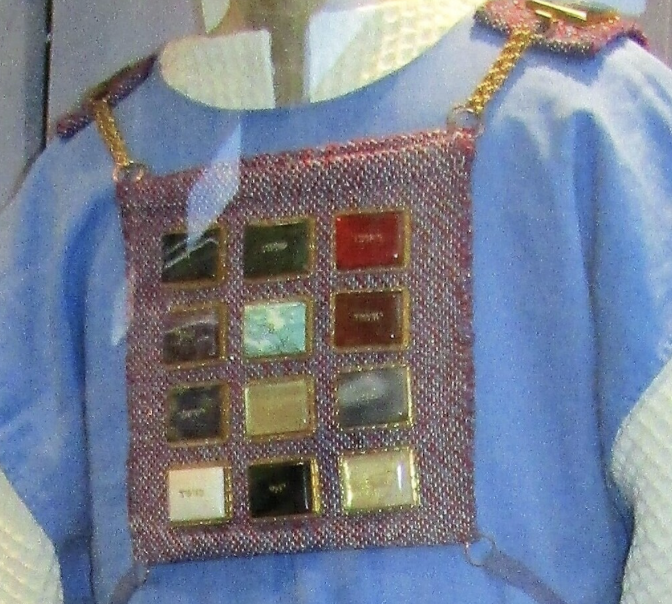
A modern attempt to recreate the High Priest’s breastplate/ephod, Wikimedia Commons

Because the Hebrew words for the precious stones in Exodus’ description of the priestly garments are rare and not well understood, we can’t be certain of the modern equivalent for each stone.
In Exodus, we learn the high priest wears a gold plate on his head inscribed with the words “Holy to the LORD” and each stone on his breastplate is inscribed with the name of one of the tribes. As the high priest enters the Most Holy Place, he bears the names of the tribes before God, and as he ministers to the people, he bears God’s name before them. In this way, he acts out his Genesis 1 status as God’s image. In Revelation, we find the foundations and gates of this massive, global-scale city are made of precious stones, the foundations with the names of the Apostles, the gates, all made of pearl, with the names of the twelve tribes. The dwelling place of the people of God is constructed of materials that represent their purpose in relationship with him.
There is no temple, sun, or moon, because God himself is there. Nations and kings will bring their wealth and grandeur, but no unclean thing or act will enter, only those who are recorded in the Lamb’s Book of Life. Some commentators, including NT Wright, argue “The city will be an enormous, perfect cube . . . because that is the shape of the holy of holies at the heart of the ancient Temple in Jerusalem (1 Kings 6.20).” The Tabernacle and Temples’ Most Holy Place was empty of people, occupied only by God’s presence, visited only by the High Priest once a year. This version is the dwelling place of God and all God’s people, God with us forever.
The river of the water of life flows from God’s throne down the city’s main street surrounded by a new tree of life, which extends along both sides of the river and yields 12 kinds of fruit, one emerging every month. Matt Fisher pointed out that the time-keeping lights are no longer present because God himself provides light, but the tree maintains a monthly schedule. The tree’s leaves are for the healing of the nations.
We discussed Jesus’ resurrected body retaining its scars, the nations retaining their distinct identities and characteristics, and the implication that some things in this life will pass into eternity with us. Some of what we do and are here in this life will endure.
But Revelation 22 is clear – there will no longer be any curse. Genesis 3, Genesis 9, and other failed temptation narratives show us a curse resulting from human sin. Here the curse is permanently dispelled.
Recalling the High Priest’s gold headpiece of Exodus 28:36 and phylacteries/tefillin of Deuteronomy 6:8, where God’s people wear his word on their heads, the inhabitants of heaven will worship God, see his face, and have his name on their foreheads.
“…the Lord God will shine on them, and they will reign forever and ever.”