March 15, 2026
In this first class, we discussed proposals for studying Genesis 1-11. Since so many of us have read this first ~10 pages of the Bible so many times, it is easy to slide right through the passage without taking much thought for the ideas in it and move on. We intend these proposals to help us break out of that approach and dig deeply.
-God wrote to us intending to communicate. Of all the things he could have said to us, these are the things he chose to come first. His interests in communicating appear to center around: Who God is, Who we are, How we relate to him and each other
-We should be willing to say, “I don’t know.” Acknowledgment of our limitations makes space for new ideas and growth.
-Be willing to put our desire to reach conclusions on hold until we have enough information and recognize sometimes the biblical authors don’t tell us everything we might like to know.
-The biblical authors (and the Holy Spirit behind them) are writing in a place and time and to an audience. We are not the original audience and don’t live in that place and time. The Spirit intended this for us, but it wasn’t originally written to us.
So we need to be humble in our interpretation. Don’t assume:
-the way we might receive these ideas today is the “correct” way to receive them
-we have superior knowledge or understanding
-the biases we have are valid
-we are somehow above the text or the authors
-difficult, challenging, or offensive ideas in Scripture are not valid
-The biblical authors are efficient. They rarely, if ever, include trivial detail.
-The biblical authors use wordplay, structured text (i.e. symmetry, parallelism, repetition, etc.), and various genres (i.e. narrative, genealogy, geography, poetry, census, law code, prophecy, apocalypse). It’s important to recognize them if we want to understand what we’re reading well.
-Because we are reading in translation, some of this literary structure and artistry is obscured by translation choices, so sometimes it will be important to consider the Hebrew version of the text. We’ll work to make this accessible to everyone.
-Biblical authors often use patterns and unusual vocabulary to link passages, even ones that are far apart in the Bible, to suggest comparisons to meditate on (i.e. Genesis 2-3 and Noah’s story, Noah’s story and Lot’s story, Jacob’s family and David’s family).
-It is natural to bring our own questions to the Bible. It isn’t wrong to do so, but if we want to understand what God is saying to us, we should set aside our questions and let God tell us what he wants us to know, focus on what he wants to focus on, and attempt to conclude (or leave ambiguous) what he wants. We should read humbly, letting the biblical authors lead us to the ideas they want to communicate.
If we do these things, we will likely encounter and understand the Bible differently than we have before.
-We should do our best to invite the Holy Spirit’s presence and guidance as we study. He’s the author and intends for us to learn, receive, and change as we study.
-God desires to communicate with us, delights in devout study of his word, and will honor our attempt to know him with deeper relationship in ways we cannot anticipate.
Pitfalls to avoid:
-valuing our background, training, and experience over the text
-defending ideas we value rather than reading to understand
-lacking humility
-avoiding discomfort
-avoiding ambiguity
-being impatient, insisting on drawing a conclusion based on what’s in front of me
-basing interpretation on a single passage without attempting to comprehend parallel or otherwise related passages
-ignoring structure or relationships between passages
-relying on our own intellect vs inviting the Spirit
-trying to be in control
If we do this Bible study well, you can expect it to be an uncomfortable experience sometimes. I don’t intend it to be abusive. I will not try to harm you with it, but I expect it will be uncomfortable to realize we don’t understand things we thought we did or that things we’ve long believed aren’t well supported or, possibly, are even wrong. When that happens, it’s tempting to defend our old position, but I would instead encourage you to pause and meditate on what the text says, what your old beliefs were, and what a new belief based on the text might look like. Then, there will be implications for the new belief. Sometimes those implications are far reaching and take a long time to comprehend. Often, our emotions are driven by the realization that changing our belief will have significant implications, which it’s uncomfortable to think about or embrace. I hope ultimately we will each be able to arrive at conclusions consistent with the text, well thought out, and integrated into a larger understanding of what the Bible is saying to us across all its books.
My intent is to keep the focus on the text itself. Sometimes though, we will introduce secondary material to give us context that may be necessary to understand the text well. We live several millennia and half a world away from the original author and audience, so our context and assumptions are likely quite a bit different than theirs. Considering topics like geography, ancient stories and religious practices, and archaeological evidence may help us understand the ancient context better. These things aren’t scripture, but they may aid us in understanding it.
Most of all though, we should maintain an attitude of humble, prayerful, Spirit-inviting meditation. This is God’s word. He uniquely understands it and can assist us in understanding. He delights in relationship with us and has given us this word for that purpose.
Consider the themes of Genesis 1, Joshua 1, and Psalm 1, the first chapters of each section of the Hebrew Bible. What do they consistently tell us?
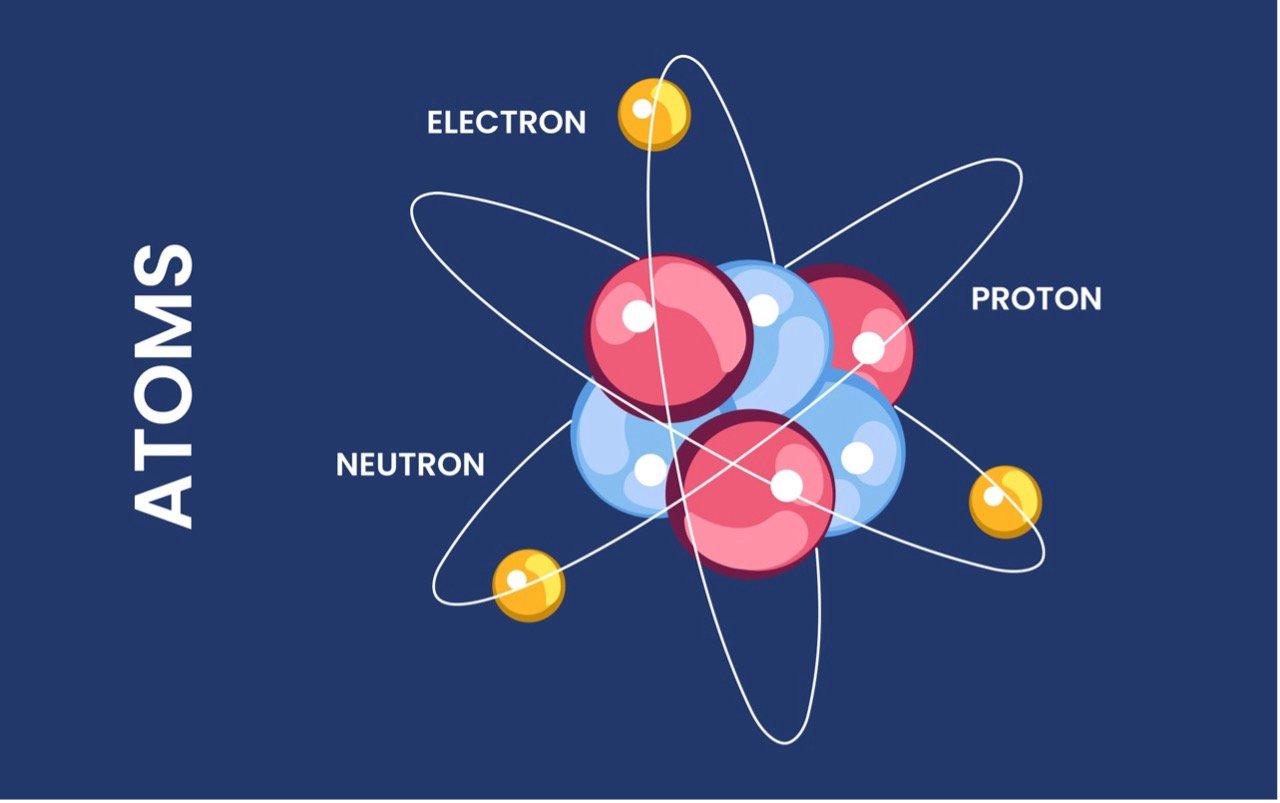
When I was in school, the textbooks used a model a lot like this to describe an atom. It’s not what an atom actually looks like. It’s a model used to show some key ideas, but it’s simplified to an extreme degree. There is benefit to teaching this model – it helps us to understand important concepts, but it isn’t the same as a real atom.
One way of interpreting Genesis 1 is as an analogy to this kind of model. It is intended to communicate key ideas. It does so in an incredibly sophisticated manner, but it’s discussing all of Creation in a single page. It will necessarily lack important detail to fully understand the origins of the universe and of life. It has the utility its author intends, but it is not designed to answer all the questions we have or support in-depth scientific inquiry.
Orality – Tonya Slaubaugh
The Israelites lived in a primarily oral culture. Scholars think it is most likely that Genesis was told orally before it was written down at a later date. We live in a primarily literate culture. Reading and writing are the main means of. communicating information and history. Neither are better or worse than the other. But they are different, in more than just speaking vs reading. Oral cultures learn differently than written cultures.
It has been my experience that the more literate people have a harder time learning through a story (and vice versa). Usually a very literate person only understands the story after someone explains it to them (exposition). The Israelites, being a primarily oral culture, would have had lots of practice with using stories to teach and learn. It’s a completely different method than the one we were taught in school.
I would like to walk you through an example (if you are willing) of learning through story.
Have someone read this story out loud:
“The Gift”
“In one seat, a wispy old man sat holding a bunch of fresh flowers. Across the aisle was
a young girl whose eyes came back again and again to the man’s flowers. The time
came for the old man to get off. Impulsively he thrust the flowers into the girl’s lap. “I can
see you love the flowers,” he explained, “and I think my wife would like for you to have
them. I’ll tell her I gave them to you.” The girl accepted the flowers, then watched the old
man get off the bus and walk through the gate of a small cemetery.” - Bennet Cerf
Take a few minutes and have everyone answer this question silently: “Which character did you see yourself in or resonate with? Why?”
Then, have a few people share their answers with the whole group. Next, have everyone turn to the person next to them and share their answers. Then, have each person ask the person next to them, “What could you learn from that character/the part of the story that resonated with you?”. Have each person discuss. Have a few people share what they learned from the story that might apply to their own life (i.e. how they might live a little differently or think a little differently about something).
Discuss this exercise as a large group. What parts of that were easy? What parts of that were hard? Did you like that? Did you not like that? Okay, now let’s do an exercise for literate learners with the same story.
Have someone read the story out loud for the group again:
“The Gift”
“In one seat, a wispy old man sat holding a bunch of fresh flowers. Across the aisle was
a young girl whose eyes came back again and again to the man’s flowers. The time
came for the old man to get off. Impulsively he thrust the flowers into the girl’s lap. “I can
see you love the flowers,” he explained, “and I think my wife would like for you to have
them. I’ll tell her I gave them to you.” The girl accepted the flowers, then watched the old
man get off the bus and walk through the gate of a small cemetery.” - Bennet Cerf
Take a few minutes and have everyone answer this question silently: “What is the point of this story?”
Then, have a group discussion with the answers from the whole group. What is the point of this story? Have everyone come to a general conclusion. Then, take the point of the story that you came up with and discuss just that concept. Next, have everyone turn to the person next to them and answer the question, “How might you apply that concept to your life?”
Okay, so now that you have done both exercises, which one was easier for you? Which one was harder for you?
Now let’s read the first chapter of Genesis, keeping in mind that in oral cultures, stories often do not have a single meaning or point (stories build upon and use other stories, but we will get to that later!)
March 29, 2026
Genesis 1:1-2:4 – read first

We’ll talk more about the structure of Genesis 1 in the future, but I think it’s important to recognize an outline from the start. The pre-creation state is darkness over the waters, an empty and undifferentiated land. On day 1, God separates light from darkness. Day two, God separates waters above from those below. Day 3, waters below recede to reveal dry land and plants emerge. Day 4, corresponding to day 1, God populates the heavens with sun, moon, and stars and gives them purpose. Day 5, corresponding to waters above and below of day 2, God populates with birds and fish. Day 6, corresponding to the land and plants emerging on day 3, God populates with animals and finally man.
There are apparent relationships between day 3, where trees are emphasized to bear fruit and day 6, where humans are blessed to be fruitful, and between day 4 where heavenly bodies are designated for signs, for seasons, and to rule over day and night, and day 6, where humans are made in God’s image to rule over animals.
Trees and animals are fruitful but do not rule. Heavenly bodies are rulers but not fruitful. Uniquely, humans are made both fruitful and as rulers.
John Sailhamer was a biblical scholar who wrote on biblical narrative and understanding its meaning. Near the end of his career, he published a popular level book discussing the early chapters of Genesis which did not receive wide acclaim within biblical studies but does contain some key ideas that make it worth considering some of his proposals.
I’ll be summarizing a book-length somewhat technical argument into a much smaller space so will inevitably present some things in a less than ideal manner. Sailhamer’s approach in his book Genesis Unbound (also here) begins in Genesis 1:1 – “God created the heavens and the land.” He suggests that a naïve reader, one who had not previously read the passage, would reasonably wonder whether this is a reference to something that has already happened or is a summary of what’s about to happen. Arriving at verse 2, where land and waters already exist, the reader would conclude that some creation has already occurred prior to the six days described in the remainder of the chapter.
Sailhamer then suggests that rather than identifying the creation of each element, the narrative of the six days recalls earlier creation (in the beginning) and describes appropriation or assignment of mostly existing creation toward the purpose of preparing a fruitful land suitable for man’s life, fruitfulness, and relationship with God.
He accepts the evening and morning phrases as indicating 24 hour days, but for him, there is no problem with defining that 24 hours because he views the sun and the earth as already made in the beginning.
For me, the real significance of Sailhamer’s approach is his recognition of the passage’s focus on the preparation of a fruitful land for relationship between God and people. We will return to Genesis Unbound as we read Genesis 2, and there he goes further to connect the fruitful land found in these initial chapters to recurring themes in later narratives.
Tonya gave us a couple of exercises that will lead us into the next section:
An Egyptian creation myth (summarized in normal English):
At first there was nothing but Nun, the primal ocean of chaos which contained the seeds of everything to come. In this jumble of waters the sun god reposed. Finally, by an exertion of will, he emerged from chaos as Ra and gave birth to Shu and Tefnut by himself. In turn Shu, the god of air, and Tefnut, the goddess of moisture, gave birth to Geb and Nut, the earth god and sky goddess. Thus the physical universe was created.
Men were created from Ra’s tears. Eons passed and Ra grew decrepit, so the ungrateful race of men plotted against Ra. When Ra learned of these plots he angrily called a council of the gods.
The gods decided that mankind must be destroyed, and Ra dispatched the goddess Hathor to wipe out humankind. Hathor did an effective job of it, killing men by the tens of thousands until only a tiny remnant was left. Then Ra relented, and men were spared. But Ra was thoroughly sick of the world and retreated into the heavens, leaving Shu to reign in his place. At that time the present world was established.
Against the orders of Ra, Geb, the earth god, and Nut, the sky goddess, married. Then Ra in his wrath ordered Shu, the air god, to separate them. Shu defeated Geb and raised Nut aloft, separating them permanently. However, Nut was pregnant, and Ra had decreed that she could not give birth in any month of any year. Seeing her plight, the god of learning, Thoth, gambled with the moon for extra light and thus was able to add five extra days to the official Egyptian calendar of 360 days. On those five days Nut gave birth to Osiris, Horus the Elder, Set, Isis, and Nepthys, successively. Osiris became the incarnation of good, while Set became the embodiment of evil. In this manner the two poles of morality were fixed once and for all.
Discussion question: what things stuck out to you that are similar to the Genesis narrative and what things are different?
A Babylonian Creation myth (summarized in normal English):
Everything originated with water. From the mixture of sweet water, Apsu, with salt water, Tiamat, the gods arose. Apsu and Tiamat gave birth to Mummu, the tumult of the waves, and to Lakhmu and Lakhamu, a pair of gigantic serpents. In turn these serpents produced Anshar, the heavens, and Kishar, the earthly world. And from these two came the great gods, Anu, Enlil, and Ea, as well as the other gods of the sky, earth, and the underworld.
Many of these new gods were noisy, which upset Apsu and Tiamat, since they could not rest. These primordial goddesses then discussed whether they should annihilate their progeny. When Ea, the all-knowing, learned of Apsu's plan to destroy the gods he used his magic to capture her and Mummu. Tiamat was furious and created a monstrous army of gods and freak creatures to punish Ea and his cohorts.
Ea went to his father Anshar, and Anshar advised him to send Anu to fight Tiamat. But both Anu and Ea were afraid of the goddess and her army. Then Ea called Marduk forth. Marduk promised to conquer Tiamat if he were given supreme authority over the gods. The gods agreed that he was to have lordship and feasted in his honor. Marduk was invested with the scepter, the throne, and an invincible weapon.
Armed with bow and arrows, lightning, the winds, a hurricane, and a special net, Marduk rode forth to meet Tiamat in his chariot, which was a tempest, drawn by four fearsome steeds. They clashed and Marduk caught Tiamat in his net. When she opened her mouth to swallow him, Marduk let loose the hurricane, which filled her jaws and belly, thereby stunning her. Then Marduk shot an arrow into her belly and killed her. Tiamat’s army fled in confusion at her downfall, but Marduk caught them in his net, chained them, and cast them into the underworld.
As he was cutting up Tiamat’s body, Marduk conceived a plan. From one half of her body he made the dome of the heavens, and with the other half he made the earth. He established the dwelling of the gods, fixed the positions of the stars, ordered the movements of the heavenly bodies, and set the length of the year. Then to gladden the hearts of the gods Marduk created men from the blood of Kingu, the general of Tiamat’s army. Finally, he made rivers, vegetation, and animals, which completed the creation. In recognition of his triumphs the gods bestowed all of their titles and powers on Marduk, making him the God of Gods.
Discussion question: what things stuck out to you that are similar to the Genesis narrative and what things are different?
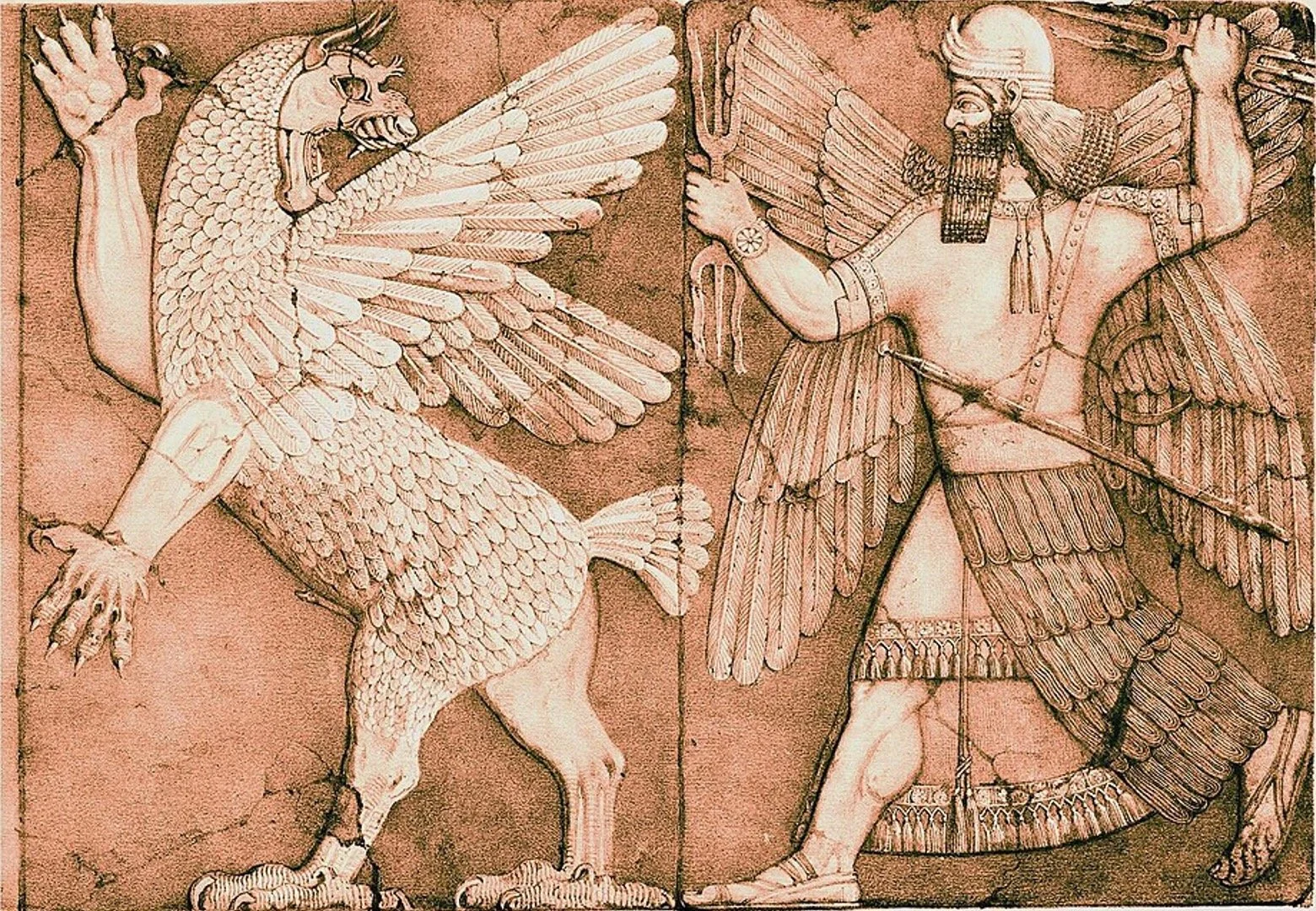
Relief-drawing from Palace of Sennacherib, Nimroud, Nineveh excavation, Mesopotamian god Ninurta (with thunderbolts) battles the gryphon-like Anzu; often associated with battle of Marduk vs Tiamat - story from Enūma Eliš. Wikimedia Commons
The similarities and differences may be significant in understanding the biblical authors’ intent. Among the similarities are pre-existing waters, separation, waters above and below in some form, the fruitfulness of the land as focus. The differences include that the biblical account lacks the violence of the others. The Bible’s humans have an elevated purpose where the others’ are slave labor. Interestingly, there is a subtle reference in the biblical account to a sea monster – on day five the word often rendered in English as “great sea creature” is elsewhere translated as “dragon,” “serpent,” or “sea monster.” Unlike the titanic struggle between the Sumerian/Babylonian/Assyrian creators and their sea monsters, Elohim of Genesis 1 speaks the sea monster into being without further remark, and it presents no threat to God or creation. The God of Genesis 1 is sovereign, desires relationship with his people, and appoints them as his image, his representatives to his creation. For God, we have value and purpose, and he’s given us an essential role in this story.
The opening line of Genesis 1 – “In the beginning, God created the heavens and the land”
The closing line of 2:4 – “in the day God created the land and the heavens”
The middle events of 1:1-2:4 are day 3, the waters receding to reveal the land, and day 4, the population of the heavens.
The culminating event of Genesis 1 creation is God forming humans, who are the image of God in the land, a connection between heaven and earth. This done, God rests on the seventh day.
April 12, 2026
Genesis 1-2:4 continued
Tonya Slaubaugh
Chapter 1
1 It all began when God created the universe.
(the Hebrew has shamayim and arets here, which are different categories that we have in English. Together they make a merism, which is a fancy word that means to use two contrasting parts of speech to talk about the whole of something. So in English we say “she searched high and low for that lost book” and “high and low” means she searched everywhere. Here it means God created everything, and in the Hebrew conception, that is both spiritual and physical realms).
2 Now when God made the earth, it was empty and lifeless — nothing but a watery abyss covered in darkness. But: God’s Spirit was hovering over the surface of the water.
(the Hebrew again has arets here instead of “earth” so keep that in mind. It’s a word that we don’t have in English. The Hebrew word that is translated as empty and lifeless is the same Hebrew word for “desert” or “wilderness” so it is a metaphor/picture, which in this context is talking about the empty and lifeless state of the earth. So if you want to include this in your telling, you might say something like “Now when God made the earth, it was empty and lifeless just like a desert”.
A watery abyss as mentioned in class was the common ancient conception of uncreated chaos. So imagine just a bunch of water in darkness. The Hebrew word for hovering is unclear, it is used of an eagle who is watching over a nest of babies and to describe a drunk man’s bones elsewhere in scripture. It is a repeated action of some kind, so at the minimum is God being consistently present in this place.
3 Then, God said, “Light, exist!” And there was light.
This is pretty much like it sounds. God wanted light, and it happened.
4 And it was exactly what he wanted.
The Hebrew has the idiom “God saw that it was good”. Imagine a time when you made something and it turned out exactly like you wanted it to. How did that make you feel? (pleased, satisfied). This is kinda like that. It’s a way that God is saying “I’m happy with this” or “I am pleased with this”. And God organized the light and the darkness, Hebrew has “separated” or “divided” the light from the darkness. It’s pretty cool that in science you literally cannot have both light and darkness at the same time…because darkness is simply the absence of light. Also see a cool later play on God bringing light from darkness metaphorically in Isaiah 9.
5 and he called the light “day” and the darkness “night”.
God calls the light day and darkness night. The word “called” in Hebrew is the same word for “name” so you could also say “God named the light “Day” and the darkness “Night”. It’s the same Hebrew word Adam uses to name the animals in Genesis 2. And that was everything that happened from the beginning to the end of the first day. Hebrew has “and it was evening and morning, day one” or something like that. Which is weird to us in English since we start our day in the morning and end it in the evening. But in the Hebrew culture, they started their day at sunset (in the evening) so this would be just like saying a whole day has passed.
6 On the second day God said, “Air, exist and make a barrier that will separate the water below from what’s above.”
In Hebrew “air” here is the word rakia, and it is often translated as firmament or dome. Ben will talk about this later, but what is important to picture in your mind in this part right now is that big blob of water with a bubble of air inside of it.
Also, go outside and look up at the sky. What color is the sky? Where does rain come from? In the Hebrew culture the way they talked about this phenomenon was that there was “water” above. We do this in English too: we say that the sun rises and sets, even though we know technically that it doesn’t and that it’s the earth that is moving.
7 And so God made the air, and used it to separate the water below from what was above.
Again, imagine a big blob of water. then God putting some air and the water going above and below that bubble of air.
8 And there it was. And God called it ‘the sky.’
And that’s everything that happened from the beginning to the end of the second day. In Hebrew the word for “sky” again is the shamayim. This is a different category from what we have in English. For now, think about it as the sky, or everything that you see when you look up. Ben will talk about this more later. (it’s hard to describe in English since the Hebrew word seems to include sky, atmosphere, space, stars, birds, and heaven all in one word. Again the Hebrew has “and it was evening and morning, the second day”.
May 31, 2026
We read Genesis 1:1-2:4 and discussed things to think about during the summer break
Stepbible.org is a great resource to do word studies as we’ve done in a couple of classes so far. You can read different translations and in ancient languages in parallel. You can mouse over words to get a definition, click on a word to get an extended definition, and click a link in the extended definition to get every instance of the word in the Bible. I usually use the New American Standard translation for word searches because it has the reputation of being close to a word for word translation.
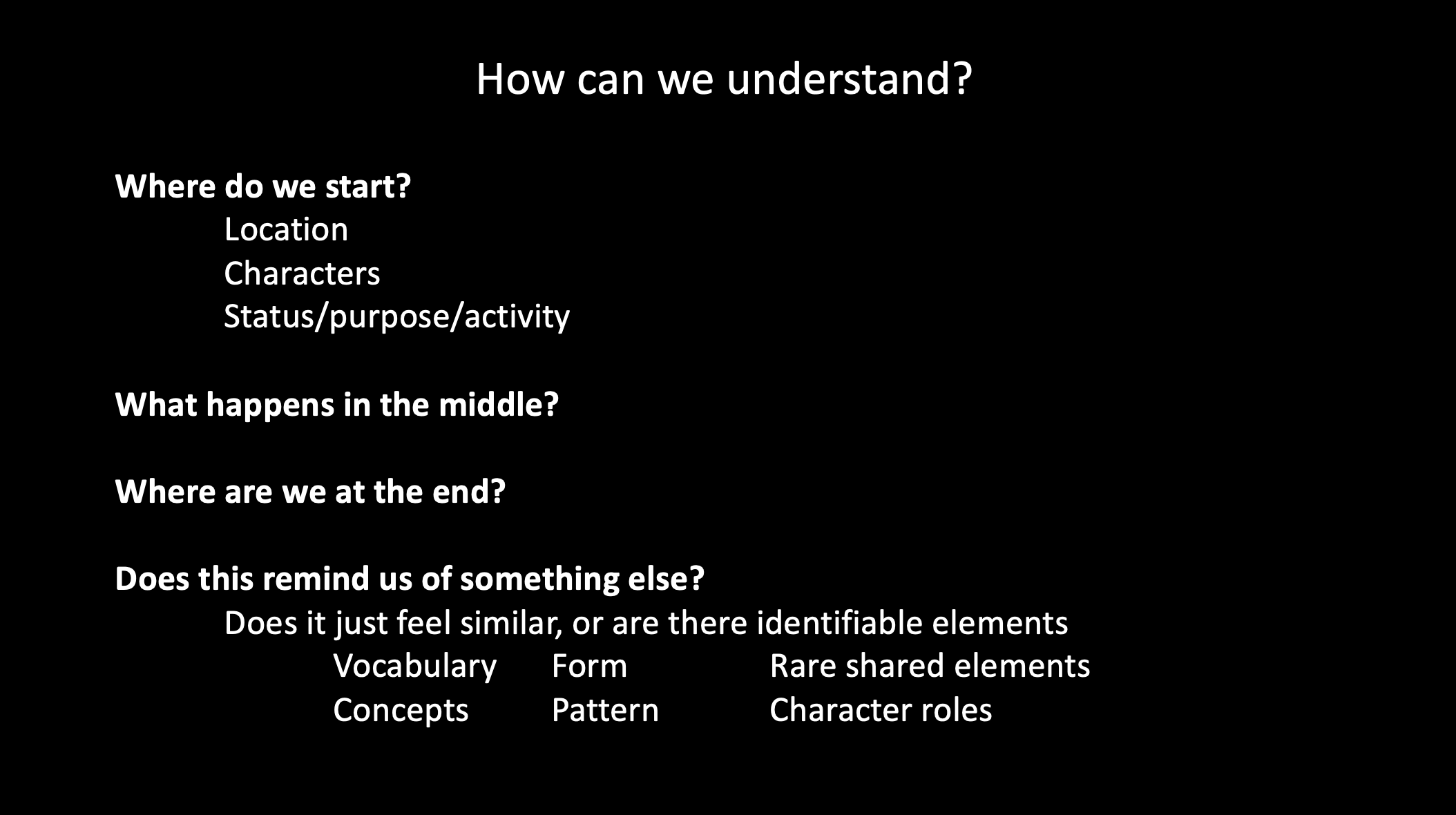
How can we understand what we read in the Bible well? It helps to understand genre – are we reading narrative, poetry, genealogy, law, prophecy, apocalypse, a letter?
Most of Genesis 1-11 is narrative, story-telling. To understand the story and biblical authors’ messages across stories, it helps to think about where we start in each – geography, who is present and their characteristics, what is happening, what direction people or things are moving.
What changes occur in the middle of the story? What is developing? What are we moving toward? What is happening to the people and things we identified in the beginning? Are new elements introduced?
At the end of a given story, we should consider where we’ve arrived both geographically and in character development. What has changed? What remains the same? What can we learn about God’s character and people’s?
We can also learn from comparison across stories, sometimes even ones that are far apart in the text. It’s common to encounter a story and have a feeling of familiarity. Where have I read this before?
That feeling may lead to a realization – this story resembles another one. By reading each story alongside the other, we may find support for that initial feeling of recognition. The Hebrew and comparative literature professor Robert Alter talks about “type scenes,” similar scenarios that occur in many stories. His prototypical example is the woman at the well, which we find in the stories of Isaac, Jacob, and Moses among others. Coincidentally, the same week we discussed similarities between stories, The Bible Bar podcast discussed “Genesis 16: Hagar and the Pattern Behind Biblical Heroes” with Edward Greenstein, Professor Emeritus of Bible at Bar-Ilan University, in which they looked at Hagar’s story as a form of the hero’s journey common in both biblical and Ancient Near Eastern literature.
We briefly discussed parallels in the stories of Noah and Lot, in which we can see a similar set of ideas – potential sexual relationship between spiritual beings and humans, God evaluating pervasive sin and preserving one family as a remnant through judgment, patriarch figure getting drunk, something illicit happening with his children, and the story ends with an origin of future Israel’s neighboring peoples (Canaan with Noah, Moab and Ammon with Lot). The parallelism is visible at the conceptual level.
In the story of Jacob sending Joseph out to check on his brothers, there is an unusual set of rare Hebrew words. In the story of the ‘spies’ sent out to explore the land of Canaan in Numbers 13-14, a Hebrew reader can find that same set of rare words. Conceptually, the similarities might be difficult to see, but at the word level, there appears to be a deliberate connection between the two stories.
If we recognize a cycle of relationship between God and people – God forms people in the wilderness, places them in a fruitful land, and gives them instruction for ongoing life, fruitfulness, and rest in the land. The people depart from God’s guidance. The relationship and the land deteriorate. God brings judgment to end the deterioration and restore the land while bringing a remnant through the judgment to start again. God gives new instruction, often intended to address the actions that brought about the previous judgment. – we can identify characters and scenarios that are in similar places in the cycle, for instance Noah and Lot are both remnant figures, preserved through judgment. By comparing characters and events at similar places in the cycle, we can learn about God’s character and people’s from the stories’ similarities and differences.
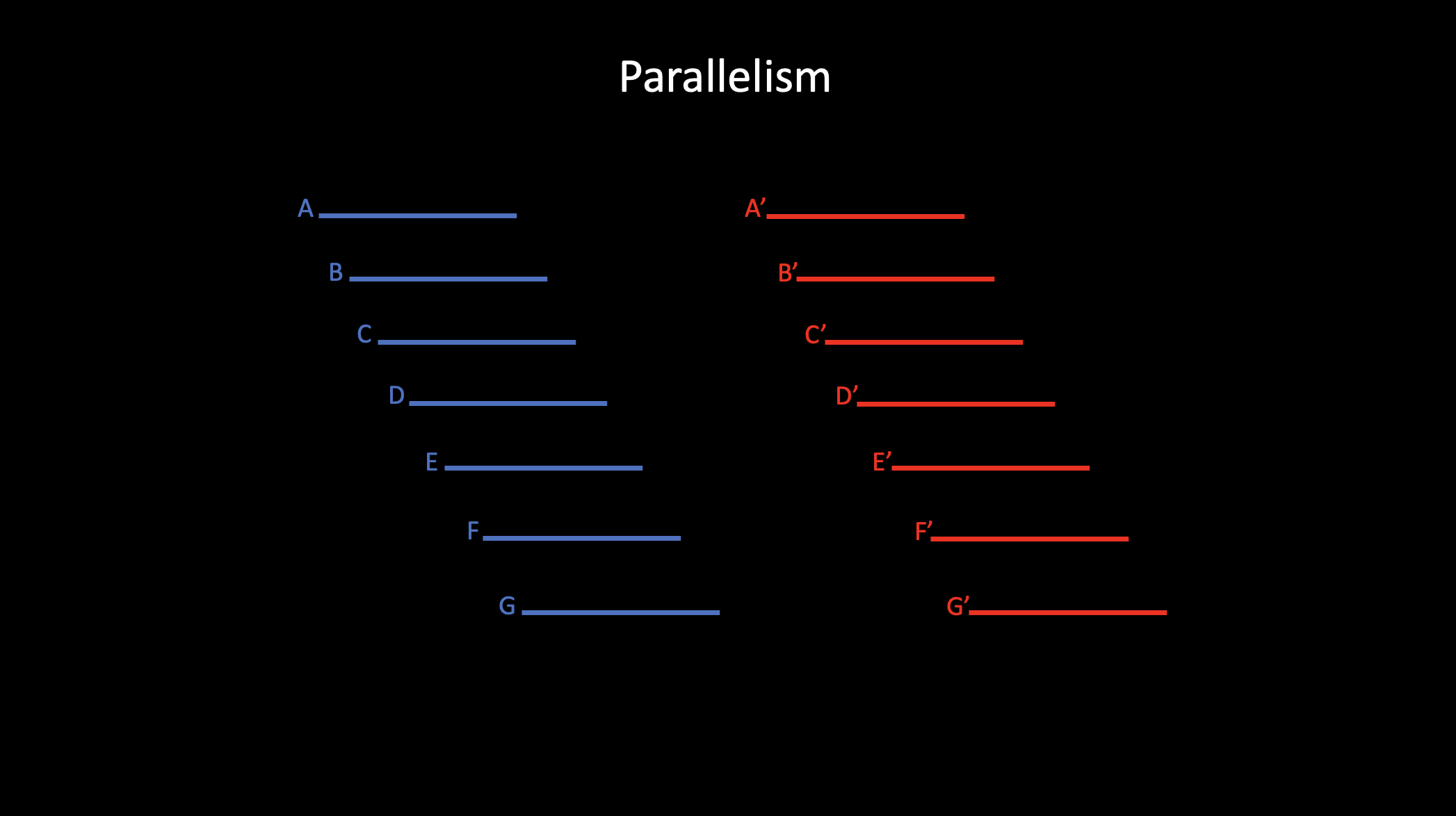
Sometimes the form of a story is significant. We’ve previously discussed parallelism in Genesis 1. The first three days of creation involve separation into domains – places of light and dark, waters above and below, dry land as separate from the waters. The second set of three days appears to populate these domains – sun, moon, and stars; birds and fish; land animals and humans. We also discussed parallelism between Noah’s and Lot’s stories.
Some biblical stories appear to display symmetry, in which there is a central idea (both structurally and important in the story) around which the events of the story correspond to each other.
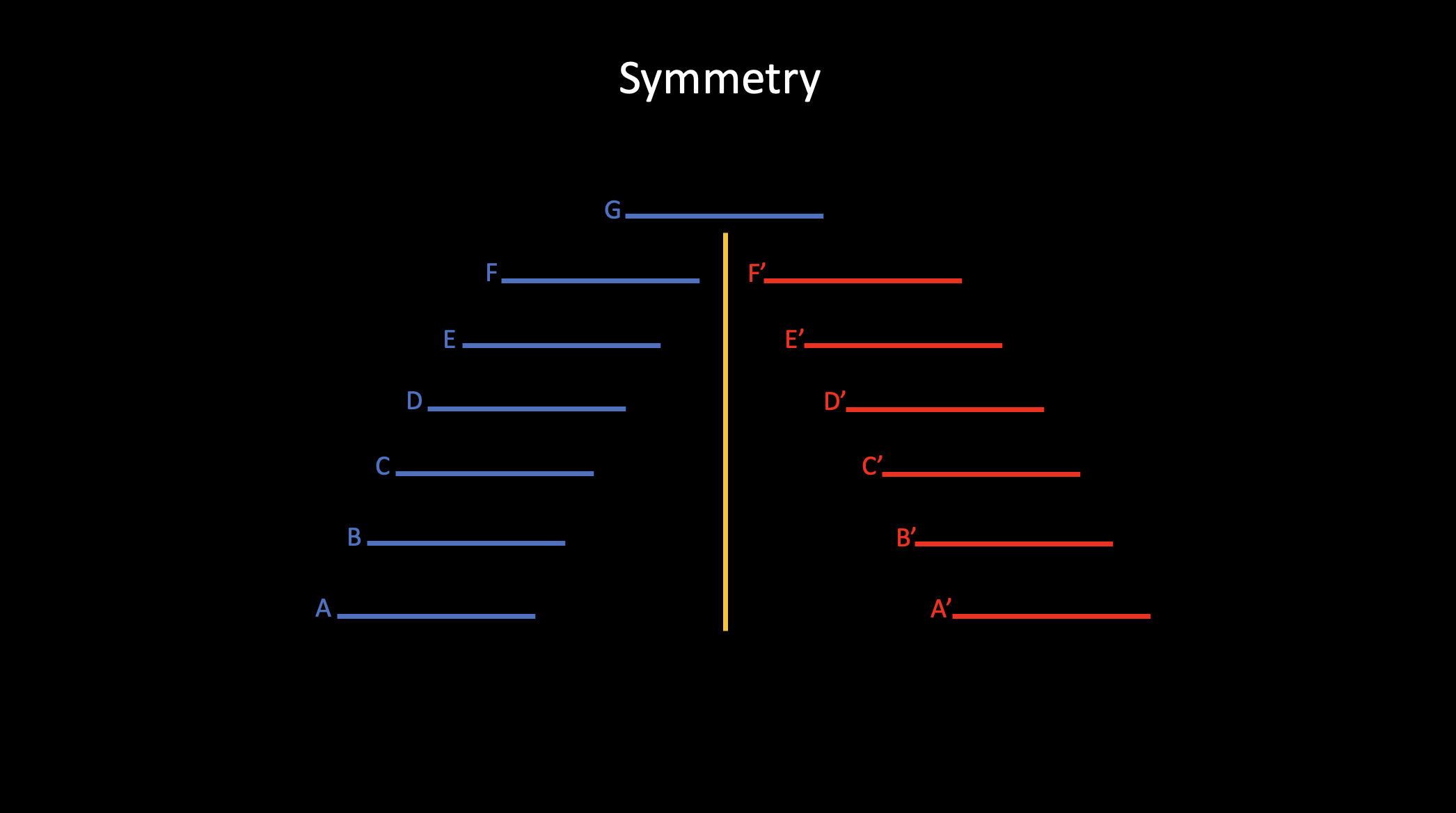
Finally, we discussed the Golden Mean. In many modern stories, musical compositions, movies, and other art forms that emerge over time, the composer/writer places the climax at or near this point. Given a line, the Golden Mean is the point where the ratio of the short part of the line is to the long part of the line as the long part of the line is to the whole.
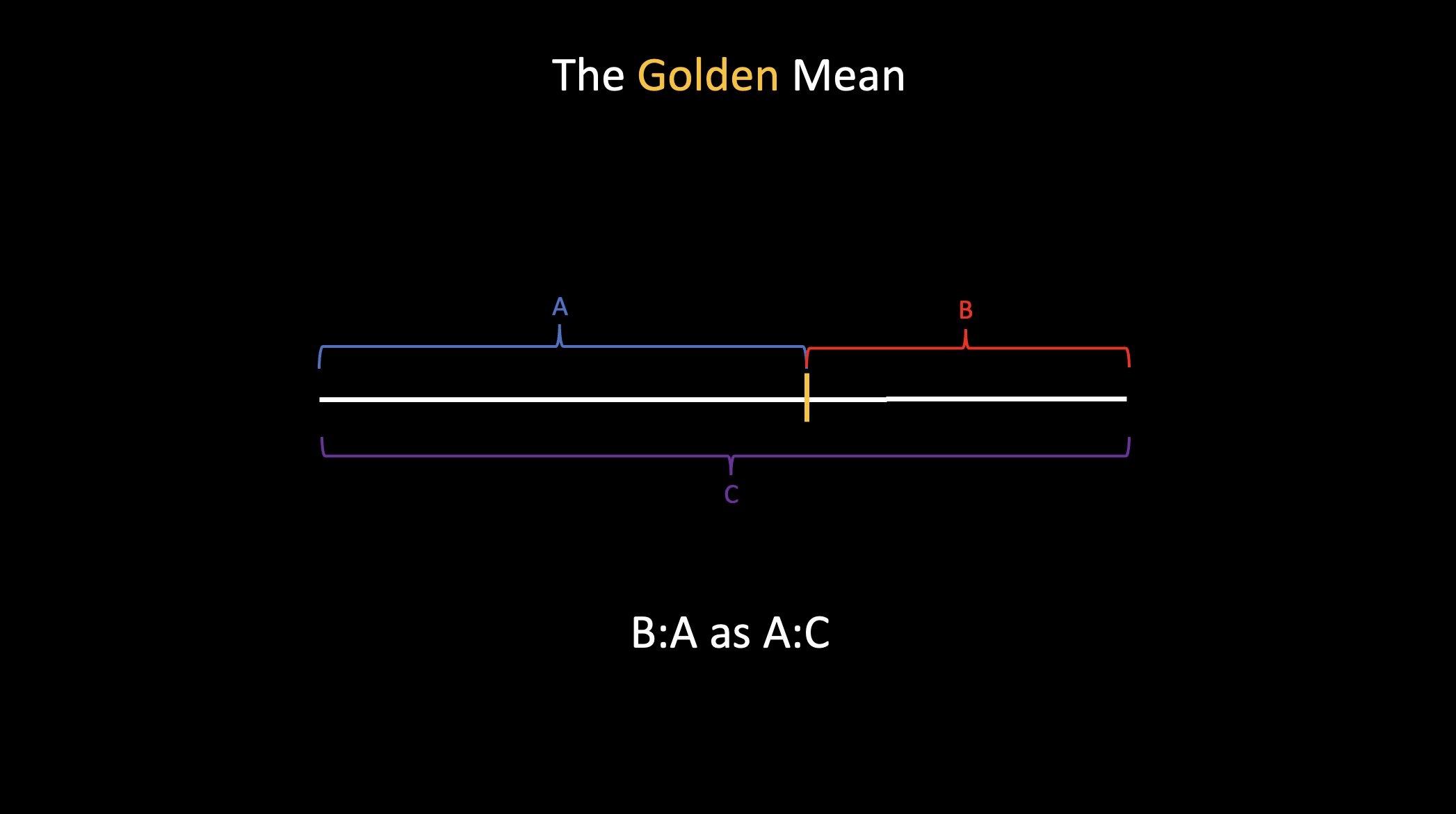
Some biblical stories may do this. For instance, if we consider Genesis 1:1- 2:4 as a single literary unit, the creation of the humans appears at roughly this point in the story.
Why think about the form of biblical stories? The biblical authors use form to communicate. Parallelism and symmetry offer opportunities to place stories or parts of stories next to each other for comparison. Meditating on similarities and differences yields insights into the character of God and of people. Recognizing God’s actions across stories changes our perception of him and informs how we act today.