September 13, 2026

We read Genesis 1:1-2:4 and discussed some housekeeping for the new start to class for the Fall.
For the foreseeable future, we’ll consider the passage verse by verse, so we started again at the beginning.
For word searches, we used Step Bible, looking at NASB (which I use because it is close to a word for word translation) and Hebrew. By mousing over a word, we can see a definition. By clicking on the word we can get additional information including the number of occurrences of that word. By clicking on the occurrences, we can see all the passages in which it appears.
We looked at the first word/phrase in the Bible “In the beginning,” which in Hebrew sounds like “b’reshit.” In his book Genesis Unbound, John Sailhamer writes about how it appears elsewhere in the Bible to get an idea of how we can interpret it here:
In Job 8:7 the word reshit refers to the early part of Job’s life, before his misfortunes overtook him. During this time Job grew into full maturity, raised his family, and gained renown for his great wisdom and prosperity. It was an unspecified, but lengthy, period in Job’s life.
Within the Book of Genesis itself, the author uses the term reshit to refer to the early part of Nimrod’s kingdom (Genesis 10:10). The NIV translates reshit in that verse as “the first centers [reshit] of his kingdom were Babylon, Erech, Adda, and Calneh ...”
When the Bible speaks of the reigns of Israel’s kings, the word reshit is used in a unique reckoning system. The first period of a king’s reign usually was not counted as part of the official length of his reign. An unspecified period was allowed during which the king actually reigned, but it was not officially counted as part of his reign. After that period—whatever its duration—the years of the king’s reign were counted in consecutive order. No one knows for certain the origin of this system of reckoning, but we know it was practiced throughout the ancient Near East.
To calculate the duration of a king’s reign, scribes started to count years only after an initial period of time, which sometimes was only a few months and at other times was several years. This indeterminate period of time before the official reckoning of a king’s reign was called “the beginning [reshit] of his reign.”
It was common in ancient Israel to begin counting the years of a king’s reign from the first of the year—that is, the first day of the month of Nisan. If the king assumed office prior to that day, as was frequently the case, the time which preceded the first of the year was not reckoned as part of his reign. That time was called “the beginning” (reshit).
In a few biblical cases “the beginning” of a king’s reign amounted to several years. According to Jeremiah 28:1, for example, the “beginning” of King Zedekiah’s reign included events which happened four years after he had assumed the throne. In this case the NIV translated the word “beginning” simply as “early in the reign of Zedekiah.”
For Sailhamer, the beginning is an indeterminate period of time during which God was at work prior to the seven days we learn about in the rest of Genesis 1. He further cites the immediate existence of the land and the ocean in Genesis 1:2 as evidence some creation has already occurred. We previously discussed that other cultures’ creation stories assumed the existence of the ocean at the start of creation, so, from an ancient perspective, they likely did not require an explanation like Sailhamer’s more modern view.
John Walton has a recent book on Genesis that, among other things, examines how Ancient Near Eastern ideas compare and contrast with biblical accounts. He has written extensively on the subject over his career. I should clarify – I’m not advocating for positions Walton, Sailhamer, and other scholars we sometimes reference or read have taken in attempt to explain Genesis 1. I hope we can take ideas from their scholarship to help us understand what the biblical authors have written.
The heavens and the earth can be received as a merism – a figure of speech that refers to something as a whole by mentioning two contrasting parts (i.e. “he searched high and low”), but even if we view it that way, the choice of “the heavens and the earth” remains significant. The author could have discussed creation in the east and the west, for instance, but chose to emphasize the two concepts of the heavens and the land (shammayim and eretz), which also close out the passage and are the subject of the middle days, day 3 revealing the dry land, and day 4, populating the heavens. When a passage shows us concepts at the beginning, middle, and twice at the end, it seems likely we should view them as significant.
Verse 2 tells us the land was “formless and empty,” which in Hebrew sounds like “tohu va vohu,” a memorable rhyming phrase that only occurs a few times in the Hebrew Bible / Old Testament. Vohu occurs in just those three places, always with tohu, so it is likely a modifier or intensifier of tohu. Tohu, which occurs far more frequently, most often means “wasteland,” “empty place,” “chaos,” “desolation,” and similar ideas.
The translation “formless and empty” along with the darkness over the deep identifies three problems that God subsequently solves by speaking light into being, by separating for three days to define form, and by populating the newly created domains over the next three days. So, “formless and empty” makes sense as a translation. Nearly every translation does something similar, but it’s also important to recognize that a literal translation from the Hebrew is something like “the land was a deserted desert,” “desolate wasteland,” or “wild wilderness.” Perceiving this is important, in my opinion, because the wilderness is a key element in an ongoing cycle of relationship between God and people. The presence of the wilderness and the sea right at the beginning emphasizes their role as foundational, meaningful components of many biblical stories to follow.
Genesis 1 uses “Elohim” as the name for God, so the Hebrew for “Spirit of God” here sounds like “ruach Elohim.” We looked at the many instances of ruach to find it has several meanings, including “wind,” “breath,” “grief” (as Brad pointed out, possibly related to sighing), and “spirit.” Recognizing these several meanings is important because translators sometimes obscure what we might otherwise perceive as literary connections. For instance, the second appearance of ruach is in Genesis 3, where God walks in the garden in the ruach part of the day. A literal translation might be “windy part of the day,” but we often see “cool of the day,” which would give most English readers no hint of the same concept that appeared in the phrase “Spirit of God.”
The multiple meanings are especially significant as we arrive at the Flood story. There, following the central phrase, “And God remembered Noah,” the ruach/wind blows over the face of the water beginning a kind of re-creation, containing a lot of shared vocabulary with Genesis 1. The vocabulary helps us recognize the Flood as a reenactment of creation following a judgment via the de-creation/un-separation of the waters as the floodgates of the heavens and fountains of the deep open. If we don’t recognize Spirit and wind as the same word, we’ll miss some elements of these parallel stories.
God speaks light into being and separates it from the darkness. We get the first instance of the phrase “there was evening and there was morning,” but this one is different than the others in that it says “day one,” rather than the “first day,” as all the others say, “the second day,” “the third day,” etc. “Day one” sounds like “yom echad,” which we’ll come back to later.
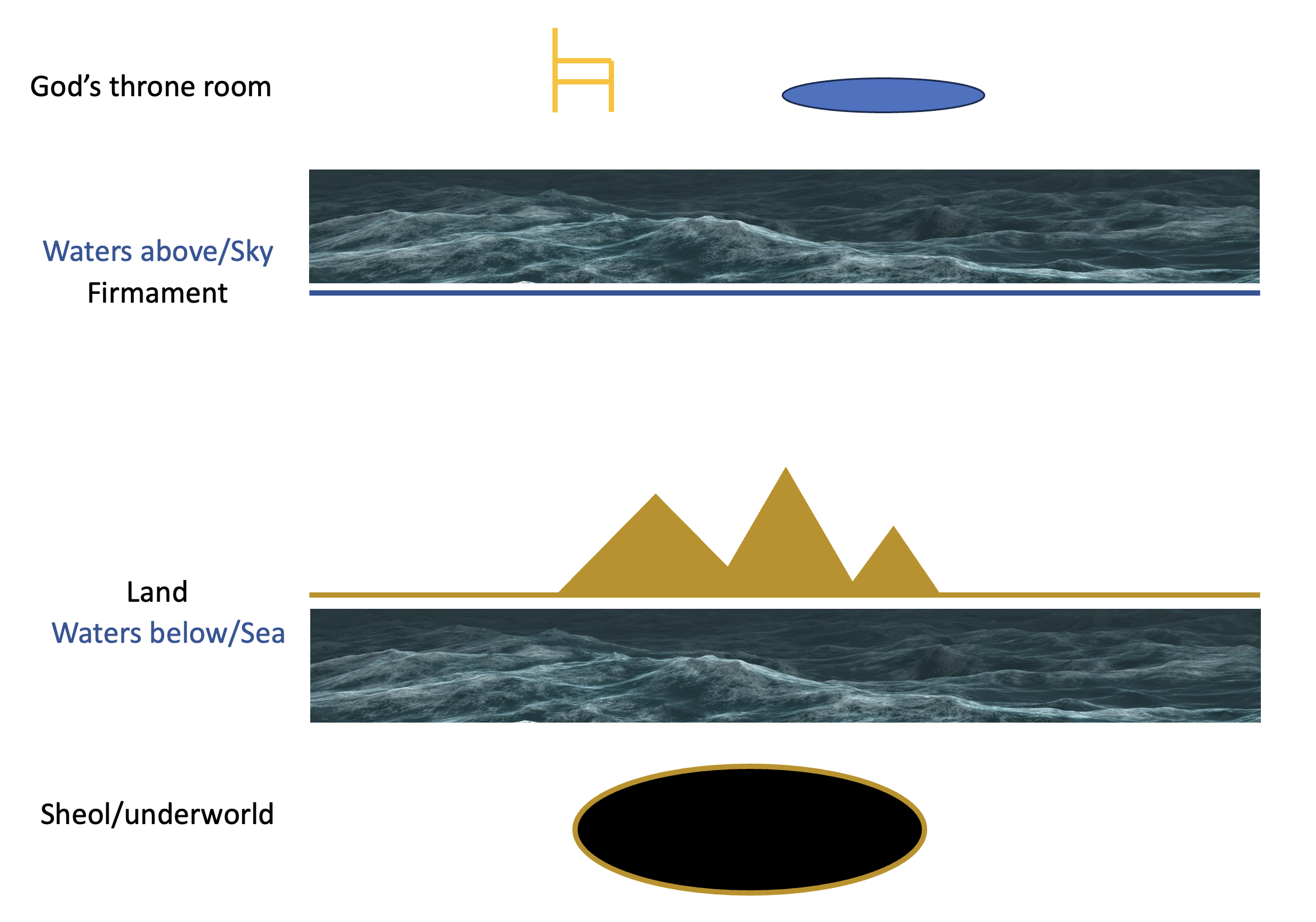
The Hebrew word often translated “expanse,” “firmament,” or “dome” sounds like “raqia.” It is a difficult concept for many modern readers to understand. We looked at its occurences in the Hebrew Bible, many of which are similar, but in Ezekiel, we find cherubim just below it and God’s throne just above. Exodus 24:10 is suggestive of it – Moses and seventy elders ascend Mount Sinai, “and they saw the God of Israel; and under His feet there appeared to be a pavement of sapphire, as clear as the sky itself.” In Revelation, we find similar imagery in God’s throne room including a sea.
The raqia functions to separate the waters above from waters below. God speaks about it, makes it, then, confusingly, names it “heavens.” Uniquely among the days, God does not call this work good.
In attempt to understand the raqia better, we looked at this graphic from Andrew Teeter’s presentation “The World Seen”:
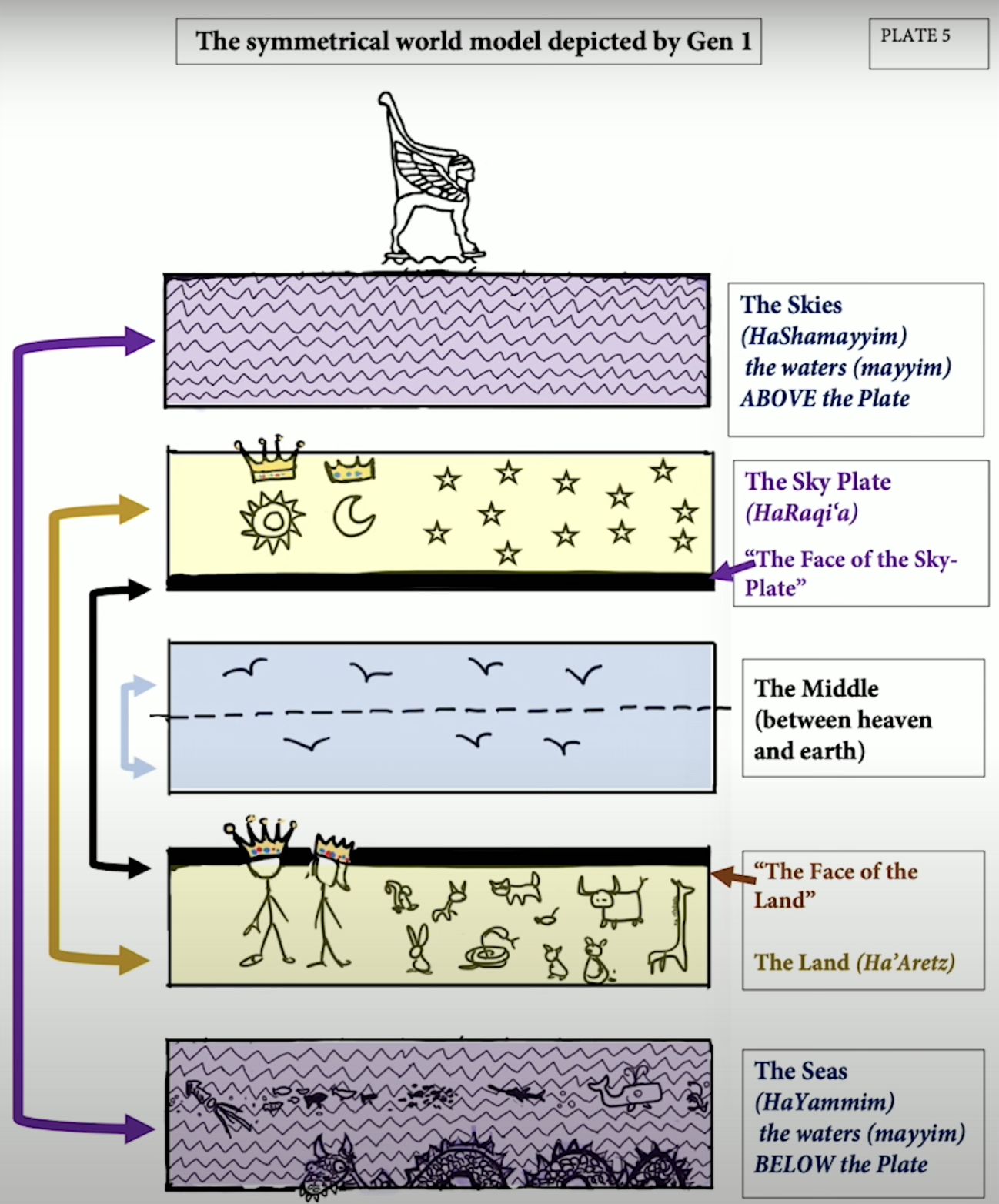
The image below includes the sea before God’s throne room and Sheol opposite God’s throne, continuing the symmetry/correspondence for an additional level.